
Current analysis
An ageing population: municipalities need to digitise critical workflows
More staff alone will not meet the challenge of an ageing population. Discover how municipalities can free up capacity by digitising key logistics and critical workflows.
Why is this relevant now?
Statistics Norway’s 2026 population projections indicate that the proportion of people over 80 is expected to rise from around five to over ten per cent by 2050. In the same year, the Office of the Auditor General concluded that many municipalities are not sufficiently prepared for the ageing population.
With staff already in short supply, the question becomes which tasks must be carried out by healthcare professionals and which can be simplified or removed.
Key logistics is more than a key
Physical keys must be collected, returned, copied, tracked and replaced. During sickness absence, temporary staffing or route changes, access often has to be coordinated manually. Each task is small, but the total becomes substantial across shifts and zones.
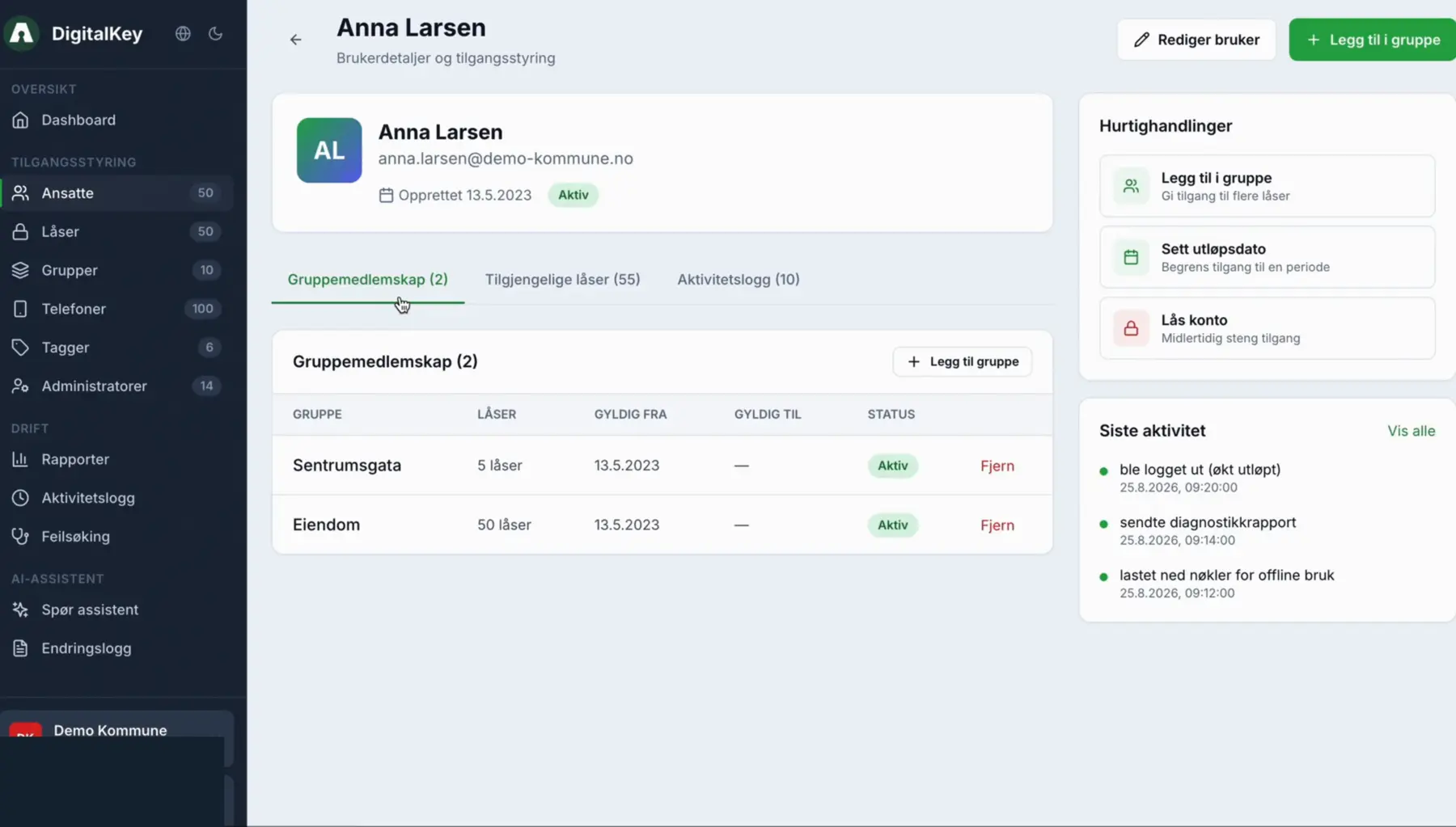
Digital access management can bring together users, roles, groups, locks and validity periods. Access can be provided through phones, key fobs, cards, PIN, NFC or other supported technologies.
Four benefits municipalities should measure
Time released
Measure minutes spent collecting, returning, searching for and administering keys per shift.
Fewer incidents
Track incorrect keys, missing access, delayed visits and manual handovers.
Faster changes
Measure the time from a need arising until the right person has the right access.
Better management information
Assess whether managers can see status, responsibility and events without collecting data from multiple systems.
Technology must be service development
The Norwegian Directorate of Health points out that welfare technology can save staff time, but technology must be connected to working processes, responsibilities, training and management follow-up.
Successful implementation therefore starts with the workflow, not the lock:
- Where do time losses and risks arise?
- Which users and door environments are involved?
- Which integrations are necessary?
- How is access created, changed and ended?
- Which benefits will be measured?
A platform rather than another silo
Municipalities often have several lock types and vendors. A vendor-independent platform can standardise identity, access and reporting without requiring the same lock everywhere. This makes it possible to reuse compatible investments and select technology according to need.
Conclusion
The ageing population is already here. Key logistics is a concrete, measurable starting point for freeing municipal capacity. The benefit comes not from making the key digital alone, but from improving the entire access workflow.
Frequently asked questions
Do digital keys solve staffing shortages?
No, but they can free up time currently spent on logistics and administration.
Must the municipality replace all locks?
Not necessarily. Compatible existing locks can be included in a platform approach.
What should be measured in a pilot?
Time spent, driving, incidents, administration time, user experience and change lead time.